
Most lenders that review an everest business funding request start with the same short list: you are an adult under your state's rules, you live in the US, you have income you can show, and you hold an active checking account. Beyond those basics, each lender weighs credit history, existing debt and income stability in its own way. This guide explains what personal loan lenders usually ask for, which documents to gather, and how to strengthen a request before you send it.
Our service is a connector, not a lender. When you complete the request form, your details may be shared with lenders in our network, and any offer, APR, term or approval decision comes from the lender itself. Approval is not guaranteed, there is no fee to use the form, and you are never obligated to accept an offer.
Basic everest business funding requirements
Lenders generally require four basics: you are at least 18 (or your state's legal minimum), a US resident with a valid address, earning steady income, and holding an active checking account in your own name.
- Age: 18 in most states for a personal loan. A few states set a higher age to sign a binding contract, such as 19 in Alabama and Nebraska, so lenders follow the local rule.
- US residency: a physical address in a state where the lender is licensed, plus a Social Security number or, with some lenders, an ITIN.
- Steady income: wages, self-employment earnings, retirement or regular benefits. Some lenders set a minimum monthly income, often somewhere around $1,000 to $2,000 after taxes.
- Active checking account: used to deposit funds and collect payments. Many lenders want it open for at least a few months with regular activity.
- Valid ID: an unexpired driver's license, state ID card or passport.
- Contact information: a working mobile number and email address, because verification codes and offer details arrive there.
Meeting every item does not mean a lender will approve a personal loan, but missing one usually ends the review early. A checking account that was closed last month or a phone number that no longer works can stop a request that would otherwise qualify.
Documents lenders commonly request
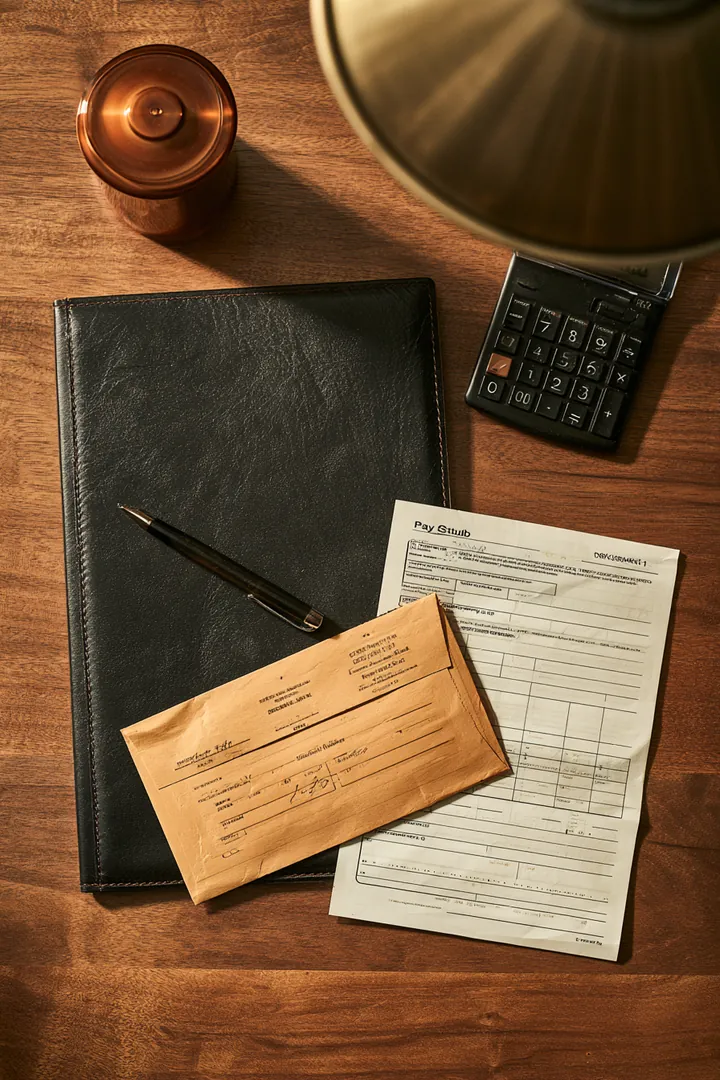
Personal loan lenders commonly request a government-issued photo ID, recent proof of income, a bank statement or account verification, and proof of address such as a utility bill or lease, usually after you accept a conditional offer.
| Document | What usually works | Practical tip |
|---|---|---|
| Photo ID | Driver's license, state ID card or US passport | Check the expiration date and make sure the name matches your request exactly |
| Proof of income | Two recent pay stubs, a benefits award letter, or bank statements showing deposits | Self-employed borrowers should have a recent tax return or 1099 forms ready |
| Bank verification | Secure online account link, a voided check or a recent statement | Use the account where your income is deposited |
| Proof of address | Utility bill, lease or insurance statement from the last 60 days | If you recently moved, keep both the old and new address documents handy |
| Identity number | Social Security number or ITIN entered on the form | A physical card is rarely needed, but the number must match bureau records |
Gig workers and freelancers tend to face the most document requests on a personal loan because their income moves around. Jordan, a rideshare driver in Arizona, keeps a folder with three months of platform earnings summaries and the bank statements that show those deposits landing. When a lender asks for proof, Jordan answers within minutes instead of days, which keeps the timeline short.
Everest funding tip: scan your documents into one folder on your phone before you open the request form. Lenders often set a deadline for uploads, and a clear, uncropped image of every page avoids a second round of requests.
How lenders weigh your credit score
Lenders treat your credit score as a quick summary of repayment history, and it strongly shapes the personal loan APR you are offered, although many lenders serving smaller amounts also weigh income and bank activity alongside the score.
A credit score in the common FICO model runs from 300 to 850. Broadly, 670 and above is considered good, 580 to 669 fair, and below 580 poor. Lenders rarely publish a hard cutoff, and some will review applicants in the 550s or low 600s when income is steady and recent payments are on time.
| Score range | How lenders often view it | What borrowers commonly see |
|---|---|---|
| 740 to 850 | Strong | The widest choice of lenders and APRs at the low end, sometimes under 18% |
| 670 to 739 | Good | Competitive offers, often from the high teens to the mid 20s |
| 580 to 669 | Fair | Fewer offers, with APRs more often in the upper 20s to 36% |
| Below 580 | Limited | Smaller amounts, shorter terms, or a co-signer or secured option |
The number is only part of the picture. Lenders also read the report behind it: recent late payments, accounts in collections, a fresh bankruptcy and many new accounts opened in a short span all count against an everest business funding request even when the score looks acceptable. For a fuller breakdown of score bands, read what credit score you need for a personal loan.
Checking offers through the request form typically uses a soft inquiry, which does not affect your score. A hard inquiry usually happens only after you pick an offer and continue with that lender's full application.
Why debt-to-income ratio matters
Your debt-to-income ratio compares monthly debt payments with gross monthly income, and many lenders prefer it below roughly 36% to 40% once the new loan payment is added, though limits vary.
The debt-to-income ratio tells a lender how much room your budget has for one more bill. A high score with a stretched budget can still be declined for an everest business funding request, while a fair score with plenty of breathing room may be approved for a smaller amount.
Consider Tasha, a medical assistant in Georgia who earns $4,000 a month before taxes. Her rent share, car payment and credit card minimums total $1,200, a DTI of 30%. If she borrows $2,000 for 12 months at 24.89% APR (a representative example), the estimated payment of about $189.98 pushes her DTI to roughly 35%. Choosing 24 months instead lowers the estimated payment to about $106.63 and keeps her DTI near 33%, though the total repaid rises.
Before you request any personal loan, list every monthly debt payment, add a realistic estimate for the new one, and divide by your gross monthly income. If the result tops 40%, a smaller request or a longer term usually reads better to lenders.
How income stability is judged
Personal loan lenders judge income stability by how long you have earned at a similar level, how regularly deposits arrive, and whether the source is likely to continue, so a consistent history often matters more than a high salary.
- Salaried and hourly workers: a few months at the current job with steady pay stubs is often enough. Recent job changes within the same field are rarely a problem.
- Self-employed and gig workers: lenders may ask for a recent tax return or three to six months of bank statements to average out uneven months.
- Retirees and benefit recipients: for a personal loan, Social Security, pension and disability income usually count because the payments are predictable.
- Seasonal workers: a full year of deposits shows lenders the slow months as well as the busy ones.
Luis, a landscaper in Colorado who wanted an everest business funding estimate for new equipment repairs, earns most of his money between April and October. He applied in January with twelve months of bank statements showing an average monthly income of $3,200. Because the lender could see the full cycle, the winter dip did not count against him the way a single slow statement might have.
Options with fair or limited credit
Borrowers with fair or limited credit can still find personal loan options by adding a co-signer, requesting a smaller amount, choosing a secured loan, or building a short credit history first, and each path carries its own trade-offs.
Add a co-signer
A co-signer with stronger credit or income can improve approval odds or the rate offered. The co-signer is fully responsible if you fall behind, and late payments appear on both credit reports, so treat the arrangement as a serious commitment.
Request a smaller amount
Lenders take less risk on a smaller personal loan, and the payment is easier to fit into your budget. At 35.99% APR over 12 months, an estimated $1,000 loan runs about $100.46 a month, while $3,000 runs about $301.37. Asking for only what the expense requires can be the difference between an offer and a decline.
Consider a secured option
Some credit unions and banks offer personal loans secured by a savings account or certificate of deposit. Rates are often lower because the lender holds collateral, but you can lose the pledged funds if you stop paying.
Build a thin credit file
If you have little or no history, an everest business funding request may be hard to place right away. A secured credit card or a credit-builder loan paid on time for six months can create a score lenders can read. Some services also report on-time rent payments.
State availability and rules vary
Personal loan availability, maximum APRs, fees and minimum terms vary by state, so the offers you see depend on where you live, and some lenders do not operate in every state.
Several states cap rates on smaller personal loans at or near 36%, while others allow higher rates for certain licensed lenders. States also set rules on origination fees, late fees and the shortest term a lender may offer. Active-duty service members and their dependents are covered by the Military Lending Act, which limits the military annual percentage rate to 36%.
Because licensing differs, a lender that funds borrowers in Texas may not lend in New York at all. Enter your current home address accurately on the request form so your everest business funding request reaches lenders that can legally serve your state. Using an old or out-of-state address usually causes a decline at verification.
Steps to improve your everest business funding odds
You can improve your odds by checking credit reports for errors, paying down card balances, lowering the requested amount, keeping deposits in one account, and fixing mismatched details before you submit the request form.
- Pull all three credit reports. Equifax, Experian and TransUnion each provide free reports. Dispute any account you do not recognize or any late payment that was actually on time.
- Lower card balances. Bringing utilization under about 30% of your limits can lift a score within one or two billing cycles, which helps any personal loan request.
- Bring past-due accounts current. A single account that is 30 days late right now weighs more than an old mistake.
- Request only what you need. Price the expense first, then add a small cushion rather than rounding up to the maximum.
- Route income through one account. Lenders read bank activity, and scattered deposits make income harder to verify on everest funding requests.
- Match every detail. Your name, address and date of birth should match your ID and credit file exactly.
- Pause new credit. Opening store cards or other accounts in the weeks before a request adds inquiries and new balances.
Andre, a warehouse lead in Ohio, had a 641 score and two cards near their limits. He paid the balances down from about 85% to under 40% of his limits over two months, and his score rose into the high 660s. His next everest funding request drew two offers instead of none. Results vary, but utilization is often the fastest lever you control.
Your pre-application checklist
A short pre-application checklist covers identity, income, banking, contact details and budget, and working through it in about twenty minutes usually prevents the most common delays once a lender reviews your request.
- Unexpired photo ID with your current legal name
- Your gross monthly income figure and its source, ready to type in
- Two recent pay stubs, benefit letters or three months of bank statements
- Checking account number and routing number for the account that receives your income
- A recent utility bill or lease showing your current address
- A working mobile number and email address you check daily
- A list of current monthly debt payments so you can estimate your DTI
- A target amount and a monthly payment ceiling you will not exceed
- A quick look at typical APR ranges on our personal loan rates page so you can recognize a fair offer
Keep the everest funding checklist in one place so you are not hunting for paperwork while an offer is waiting. When everything is gathered, you can start your request on the apply page in about five minutes.
What happens after you submit
Lenders in our network may review your everest funding details after you submit, and any lender that can make an offer shows its APR, term, monthly payment and fees before you agree to anything.
Compare personal loan offers on total cost, not just the monthly payment, and keep your everest funding notes side by side. As a representative example, borrowing $2,000 for 12 months at 24.89% APR works out to about $189.98 a month, $2,279.78 repaid in total and $279.78 in interest. Treat every figure as an estimate until the lender's final disclosure confirms it.
If you accept, the lender may verify documents and run a hard credit check before final approval. Many lenders send personal loan funds within one to three business days after signing. If no offer appears, nothing is lost: adjust the amount, strengthen the weak area from this guide, and try your everest business funding request again once your profile improves.
Frequently Asked Questions
Can I qualify if most of my income is paid in cash?
Possibly, but cash income is harder to verify. Lenders typically want to see it deposited into your checking account on a regular schedule, so depositing tips or cash wages consistently for at least two or three months builds a record they can review. Keep a simple income log and any employer statements, and expect some lenders to decline income they cannot trace through bank activity.
Does a co-signer have to live in the same state as me?
Rules depend on the lender. Some accept a co-signer anywhere in the US, while others require both people to live in a state where the lender is licensed. The co-signer usually goes through the same identity, income and credit checks you do, so confirm the lender's requirements before asking someone to share responsibility for a personal loan with you.
Will checking my eligibility through the request form lower my credit score?
Submitting the request form and reviewing offers typically involves only a soft inquiry, which does not affect your score. A hard inquiry usually happens only when you choose an offer and continue with a lender's full application. One hard inquiry tends to lower a score by a few points for a short time, and lenders disclose the type of check they run.
Can unemployment or disability benefits count as qualifying income?
Many lenders accept regular benefits such as Social Security, disability or pension payments because they arrive on a predictable schedule. Unemployment benefits are treated less consistently since they are temporary, and some lenders exclude them entirely. Have your latest award letter and bank statements showing the deposits ready, and borrow only an amount the benefit can comfortably repay.