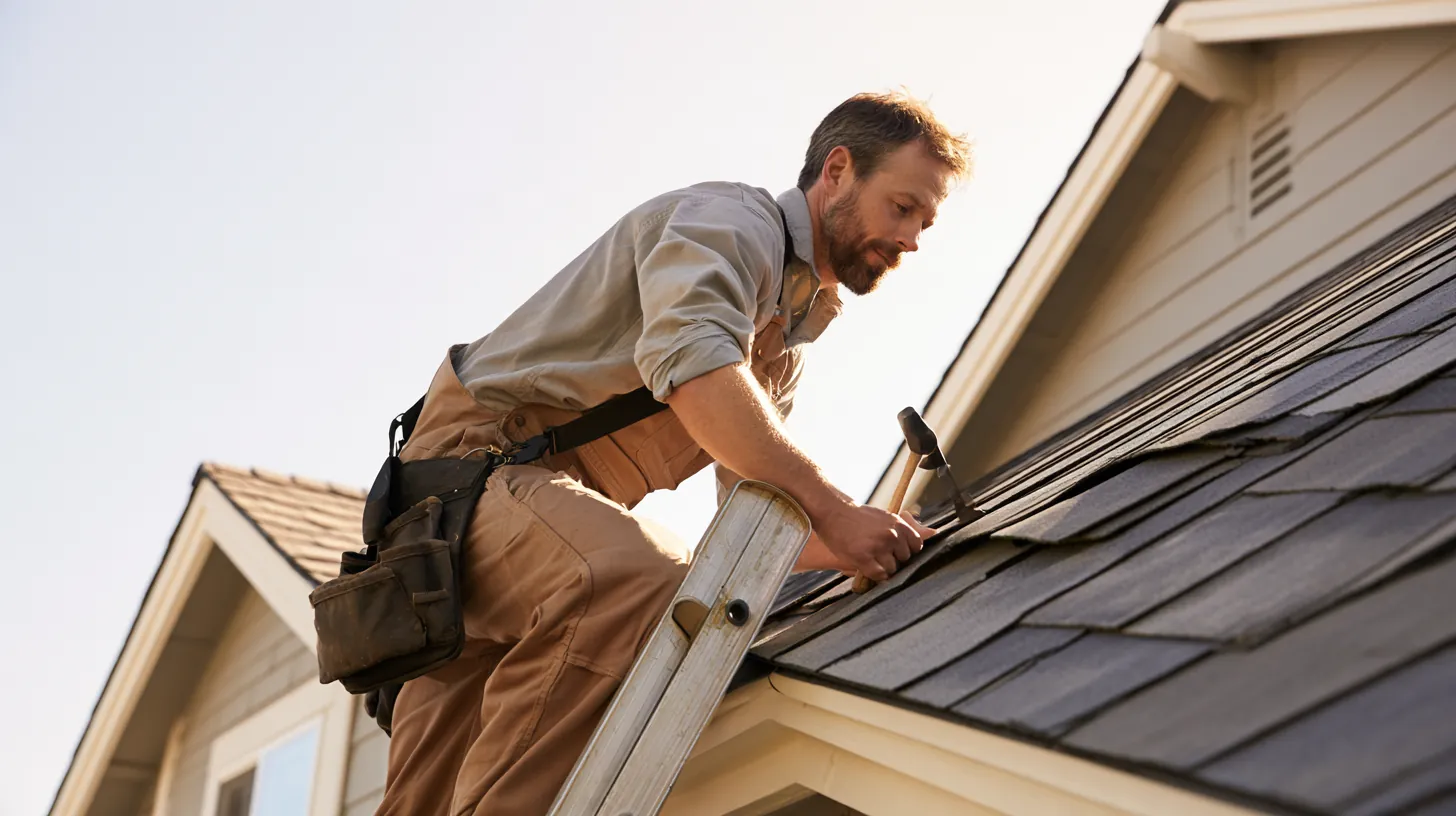
A brown ring on the ceiling, a drip that only shows up during heavy rain, a curled shingle you spotted from the driveway: roof leaks rarely announce themselves politely. Whether you are building a budget from savings or looking at everest business funding style requests for a short personal loan, the first job is the same. You need a realistic sense of what the repair should cost before a roofer names a price.
This budget guide breaks roof leak repairs into the categories roofers actually price, explains how a homeowners insurance claim and its deductible fit in, covers the cheap temporary steps that protect your home in the meantime, and shows how to pay the remaining bill without overextending. It focuses on targeted repairs, not full re-roofing projects.
What roof leak repairs typically cost
Most roof leak repairs cost between about $300 and $1,500, while a larger section repair involving decking can reach $2,000 to $5,000. These are rough national estimates; your price depends on roof pitch, material, access and local labor rates.
| Repair type | What it involves | Typical estimated range |
|---|---|---|
| Minor patch or sealant | Resealing a nail hole, small crack or exposed fastener | $150 – $400 |
| Shingle replacement (small area) | Swapping 5 to 20 damaged or missing shingles | $250 – $800 |
| Flashing repair | Resealing or replacing metal around a chimney, wall or skylight | $300 – $1,200 |
| Plumbing vent boot | Replacing a cracked rubber collar around a pipe | $150 – $450 |
| Valley repair | Rebuilding the channel where two roof slopes meet | $500 – $1,800 |
| Section repair with decking | Removing shingles, replacing rotted plywood, new underlayment | $1,000 – $5,000 |
Add interior costs if water has already come through: drywall patching and repainting a ceiling often run $300 to $1,000, and wet insulation in the attic may need replacing. Mold remediation, if moisture sat for weeks, can add significantly more.
Patch or section repair: how roofers decide
A patch works when the damage is isolated and the surrounding roof is sound, while a section repair makes sense when the decking underneath is soft, the leak has returned after earlier patches, or several problems sit close together.
Roofers usually start in the attic, tracing water stains back to the high point, then go up and probe the surface. A spongy feel underfoot signals rotted decking, which a patch cannot fix. Ask your roofer to explain exactly where the water is entering, because the stain on your ceiling is often several feet away from the actual hole.
- Choose a patch when one or two shingles blew off, a vent boot cracked or a fastener backed out.
- Choose a section repair when the plywood is soft, staining covers a wide area or you have patched the same spot before.
- Get a replacement opinion when shingles are brittle and curling across the whole roof and leaks show up in multiple places. That is a different project and a different budget conversation.
Consider Theo, a high school teacher in Columbus. Two roofers looked at his leak. One recommended a $350 vent boot swap; the other found soft decking around the boot and quoted $1,900 to replace a 6-by-8-foot section. Theo asked the first roofer to check the decking, and he confirmed the rot. The higher quote was the honest one, and patching would have meant paying twice.
Protect the house while you wait for a roofer
Temporary leak protection costs very little and can prevent hundreds or thousands of dollars in interior damage, so take these steps the same day you notice water, even if the permanent repair is a week away.
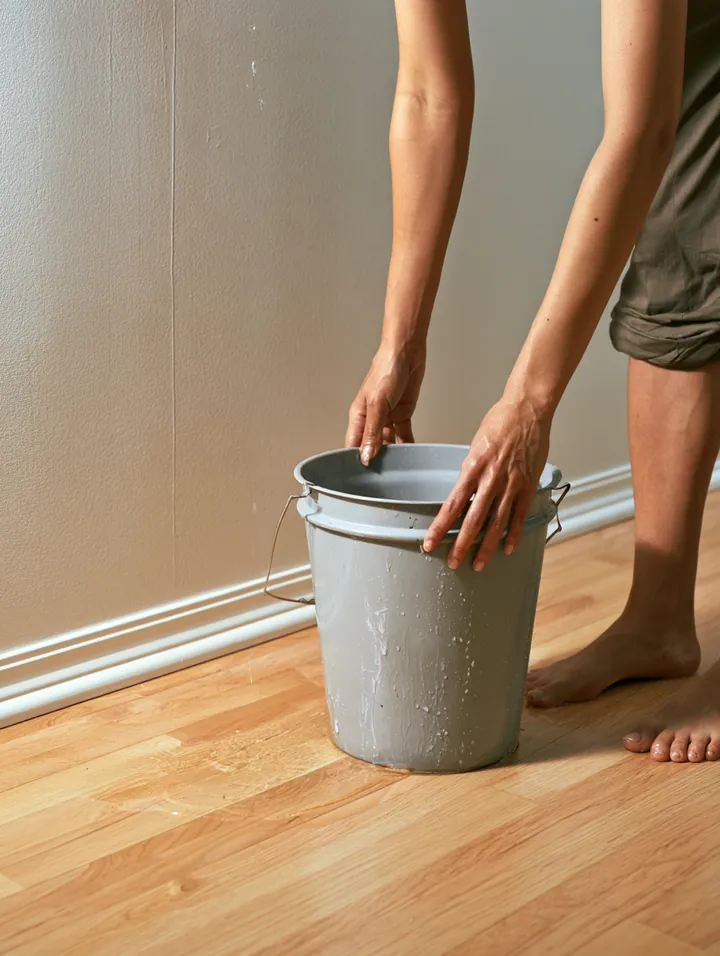
- Catch the water. Set a bucket or storage tote under the drip and lay towels around it to protect the floor.
- Relieve a bulging ceiling. If drywall is sagging with trapped water, poke a small hole at the lowest point over the bucket so it drains instead of collapsing.
- Move valuables. Shift furniture, electronics and rugs out of the drip zone.
- Check the attic. Place a tray on the rafters under the leak and pull back soaked insulation so it can dry.
- Tarp the roof only if it is safe. A roofing tarp and furring strips cost roughly $50 to $150. Never climb a wet or steep roof; many roofers will tarp for $200 to $600.
- Document everything. Take photos and video of the stain, the drip and any exterior damage before cleanup. Your insurer will want them.
Insurance claim basics and how your deductible works
Homeowners insurance usually covers roof leaks caused by sudden events such as wind, hail or a falling branch, but typically excludes leaks from age, wear or poor maintenance. Your deductible is subtracted from any covered amount.
Pull up your policy and find two numbers: the deductible and whether roof coverage pays replacement cost or actual cash value. Many policies in storm-prone states use a separate percentage deductible for wind and hail, such as 1% or 2% of the home's insured value, which can be far larger than a standard flat deductible.
| Scenario | Repair cost | Deductible | Insurer pays | You pay |
|---|---|---|---|---|
| Wind damage, flat deductible | $2,800 | $1,000 | $1,800 | $1,000 |
| Hail damage, 1% of $300,000 | $2,800 | $3,000 | $0 | $2,800 |
| Worn shingles (excluded) | $1,200 | n/a | $0 | $1,200 |
If your repair is barely above the deductible, think carefully before filing. A small claim can still appear in your insurance history and may affect future premiums. When a claim does make sense, call your insurer promptly, keep receipts for any temporary repairs, and let the adjuster inspect before major work begins whenever possible.
How to choose a roofer you can trust
A trustworthy roofer is licensed where your state requires it, carries liability and workers' compensation insurance, provides a written itemized estimate and offers a workmanship warranty on the repair itself.
- Get at least two written estimates that list materials, square footage and labor separately.
- Ask for proof of insurance and verify the license with your state or city.
- Request before-and-after photos of the repaired area.
- Ask how long the workmanship warranty lasts; one to five years on a repair is common.
- Avoid anyone who knocks on doors right after a storm, demands full payment up front or offers to cover your deductible, which can be insurance fraud.
A reasonable deposit for materials, often 10% to 30%, is normal on larger section repairs. Paying the full amount before work begins is not.
Build a repair budget before you call anyone
A roof repair budget should cover the repair itself, interior cleanup, a 10% to 15% cushion for hidden damage, and any deductible, so you know the real number before deciding whether to dip into savings or borrow.
Here is how Lena, an office manager outside Kansas City, mapped hers after a storm tore off a section of shingles:
- Estimated section repair with flashing: $2,200
- Ceiling patch and paint in the bedroom: $450
- Cushion for hidden decking damage (about 12%): $320
- Total working budget: $2,970
- Insurance payout after her $1,000 deductible: $1,200 on the covered roof portion
- Remaining gap: about $1,770
Lena had $700 in her emergency fund she was willing to use, which left roughly $1,070 to cover with a small personal loan. Writing the numbers down kept her from borrowing the full $2,970 out of stress.
Paying for a roof leak repair with everest business funding options
Homeowners usually pay for roof leak repairs with savings, an insurance payout, a roofer's payment plan, a credit card or a fixed-rate personal loan. The best choice depends on the size of the gap and how fast you can repay it.
Many people searching everest business funding for a roof repair are really looking for a straightforward personal loan between $500 and $5,000 that they can repay on a fixed schedule. Compared with carrying a credit card balance at a variable rate, a personal loan offers a set end date and a payment that does not change.
| Option | Works best when | Watch out for |
|---|---|---|
| Emergency savings | The gap is small | Draining the fund completely |
| Roofer payment plan | The roofer offers short, interest-free installments | Fine print and late fees |
| Credit card | You can repay within a month or two | High variable APR on carried balances |
| Personal loan | You need $500 to $5,000 over 6 to 36 months | Origination fees; borrowing more than needed |
Our home repair loan options for roofing and other urgent fixes explain how a request works for household repairs. This guide deliberately stays with targeted leak repairs; a complete re-roof is a different project with a different budget.
When a personal loan fits a roof repair, and when it does not
A personal loan fits a roof repair best when the gap is a known, one-time amount between $500 and $5,000, your income is steady, and you can repay within about 6 to 24 months without straining other bills.
Personal loans are designed for exactly this kind of defined expense. You borrow a lump sum, pay the roofer, and repay in equal installments. Because most personal loans are unsecured, your house is not used as collateral, which is one reason homeowners often prefer them for smaller, well-defined repairs.
- Good fit: a $1,800 section repair after your insurer paid part of the claim, with a payment you can cover from your regular paycheck.
- Good fit: a storm repair that cannot wait for you to rebuild savings over several months.
- Poor fit: a roof that needs full replacement; a small personal loan will not cover it, and patching a failing roof repeatedly wastes money.
- Poor fit: a budget where the new payment would push you into missing rent or utilities.
Before choosing between personal loans and other options, compare the total cost, not only the monthly figure. A longer term lowers each payment but adds interest, so match the term to how quickly you can realistically pay the repair off. If two lenders offer similar APRs, the one with no origination fee usually costs less overall.
Also check the lender's policy on early payoff. Many personal loans have no prepayment penalty, which means you can send an insurance reimbursement or tax refund straight to the balance and finish early.
Estimated monthly payments for common roof repair amounts
Monthly payments for a roof repair personal loan depend on the amount, term and APR you are offered. The figures below are estimates from precomputed amortization tables and assume a fixed rate with no fees.
| Amount | 12 months at 24.89% APR | 24 months at 24.89% APR | Total repaid at 24 months |
|---|---|---|---|
| $1,000 | $94.99/mo | $53.32/mo | $1,279.59 |
| $1,500 | $142.49/mo | $79.97/mo | $1,919.39 |
| $2,500 | $237.48/mo | $133.29/mo | $3,198.98 |
Representative example: borrowing $2,000 for 12 months at 24.89% APR comes to an estimated $189.98 per month, about $2,279.78 repaid in total and $279.78 in interest. Many borrowers see APRs roughly between 18% and 36%, depending on credit, income and state rules. Try other amounts in our loan payment calculator, and check typical personal loan rate ranges before you compare offers.
An everest funding estimate like this is only a starting point. Approval is not guaranteed, and the lender sets the final APR, term and amount.
Prevent the next leak and lower future costs
Routine roof maintenance, including twice-yearly inspections, gutter cleaning and quick fixes to small issues, costs far less than water damage and helps keep future repairs in the low hundreds instead of the thousands.
- Walk around the house each spring and fall and look for missing shingles, lifted flashing and granules piling up in gutters.
- Clean gutters so water does not back up under the roof edge.
- Trim branches that overhang the roof.
- Check the attic after heavy storms for fresh stains or damp insulation.
- Set aside $25 to $50 a month in a home repair fund; even a small cushion shrinks your next everest funding request or eliminates it.
One more everest funding note: if you do borrow, set up autopay so you never miss a due date, and put any refund from the roofer or insurer straight toward the principal.
Your next steps after finding a leak
Start with temporary protection and photos, call your insurer if a storm caused the damage, collect two written roofer estimates, then build a budget that shows the exact gap you need to cover.
If borrowing still makes sense, an everest business funding request through our short form is free and carries no obligation. Lenders in our network review it, decide whether to make an offer and set the terms. Compare the APR, fees and monthly payment, accept only what fits, and get the roof sealed before the next storm.
Frequently Asked Questions
How soon should a roof leak be repaired before damage gets expensive?
Aim to have a roofer inspect within a few days and complete the repair within one to two weeks. Water that keeps entering can soak insulation, rot roof decking and encourage mold, turning a $400 patch into a several-thousand-dollar section repair plus interior work. Use a tarp and buckets in the meantime, and keep photos of the damage in case you file an insurance claim.
Should I file an insurance claim if the roof repair is only slightly above my deductible?
Often it is not worth it. If a $1,300 repair sits against a $1,000 deductible, the insurer would pay only $300, while the claim may stay on your record and could influence future premiums. Many homeowners pay small storm repairs out of pocket and reserve claims for larger losses. Ask your agent how claims affect your specific policy before you decide.
Can I get a personal loan to pay my roofer if my credit is only fair?
Possibly. Some lenders work with fair credit, especially for smaller amounts, but you may see a higher APR and a lower approved amount. Keeping the request close to the actual repair gap, showing steady income and reducing other balances can help. Approval is never guaranteed, and the lender decides the final rate, term and amount based on its own review.
Related Posts

Can I Finance an Emergency AC Repair With a Personal Loan?
Rough AC repair costs, warranty checks, contractor financing versus a personal loan, and a realistic heat-wave timeline for getting cool air back.

How Much Does Emergency Vet Care Cost?
Rough emergency vet cost estimates for exams, tests and surgery, plus how to get a written estimate and pay the bill.